"We are committed to excellence through continuous provision of resources for :-
new technology, training and personal development”.
The expectations placed on dental surgeons have never been greater.
An evolving profession, an increasingly informed patient base, and the ever-present influence of media all shape the demands of modern dental practice. Today’s dental surgeon must be guided not only by clinical expertise, but by the expectations of a sophisticated and discerning marketplace.
At McDowell + Service, we understand that pressure — and we’re here to help you meet it.
By staying at the cutting edge of dental technology and innovation, we ensure our work rises to meet yours. Our goal is simple: to build a partnership between surgery and laboratory that is seamless, enduring, and forward-thinking — keeping you and your practice consistently one step ahead.
Good communication between dentist and laboratory is fundamental to a successful outcome — for you and your patients. It takes many forms: lab prescriptions, phone calls, photographs, and more. Since time is valuable to everyone, here are a few simple steps that can prevent unnecessary delays.
a) Lab Prescriptions. McDowell + Service provide two dedicated prescription forms: one for Crown & Bridge and one for Removable Prosthodontics. Please ensure the following details are always included:
It is surprising how often these basic details are missing, resulting in avoidable delays for everyone.
b) Full Arch Impressions. Please provide full arch impressions in rigid trays wherever possible. This allows technicians to establish correct occlusal relationships. Please note: McDowell + Service cannot accept responsibility for occlusal errors arising from the use of quadrant impression techniques.
c) Bite Registration & Facebow Recording. Poor interocclusal records remain one of the most common problems in restorative dentistry. Errors can arise from distorted impressions, air voids in impression material, incorrect tray selection, or improper use of facebows and articulators. For cases requiring cast mounting, accurate interocclusal records are essential.
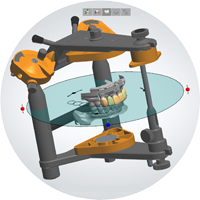
McDowell + Service recommend the Denar articulator. An ideal bite registration material should offer the following properties:
Recommended materials include: Polyvinyl Siloxane (e.g. Blu-Mousse), Acrylic Resin (e.g. Duralay LS), and good quality wax.
Please refer to our downloads section for guidance on correct prep design for each restoration type. A recurring challenge for crown and bridge technicians is insufficient tooth reduction — most restoration types require an absolute minimum of 1.5mm of clearance to accommodate the chosen material, whether that be metal-ceramic, all-ceramic, or zirconia-based.
For all-ceramic restorations, sharp line angles and 90° corners should be avoided, as these can create stress fractures within the ceramic — sometimes not immediately apparent. Before dispatching impressions, please check for:
When prescribing zirconia or CAD/CAM restorations, avoid ‘J’-type margins. Smooth, consistent finish lines are essential for an accurate fit — irregular or saw-tooth margins create significant difficulties for the technician.
Digital photography is a powerful communication tool. Whether using a dedicated camera, smartphone, or tablet, please send us:
Please note: shade cannot be taken from a photograph alone — shade tabs must always be included. That said, good photography gives the technician invaluable reference for characterisation, texture, and fine shade detail. The more information provided, the more accurate the result.
Different restorations have different properties, limitations, and indications. While the technician is always on hand to advise, the clinician bears ultimate responsibility for material selection — and for informing the patient of the advantages and limitations of each option available to them.
Delaying responses to queries from either party leads to frustration and unnecessary delays. A quick phone call or email can make all the difference — email is often an efficient alternative when an immediate conversation isn’t required.
1. Do you use CE-approved materials?
In light of recent industry concerns, it is essential to know that your laboratory sources reputable, traceable materials. Don’t hesitate to ask for documentation.
2. Do you use genuine manufacturer components for implant restorations?
Counterfeit implant components are more prevalent than many realise — some of poor quality. Ensure your laboratory uses only verified, reputable parts and provides full documentation of what was used. Sub-standard copies put both you and your patient at risk.
3. How do you carry out quality control?
Quality work takes time. Ask whether your laboratory operates under recognised quality systems such as DAMAS or ISO, and whether its technicians are fully trained and registered.
4. Do you send work offshore?
Many laboratories outsource to countries with lower labour costs. If a crown is priced at £30, it is reasonable to question whether it truly contains the alloys specified. Know where your work is made.
5. May I visit your laboratory?
A quality laboratory should welcome inspection. Look for a clean, well-organised environment and ask to see quality certificates if not already displayed.
6. Can you build a working relationship with the owner?
The dentist-laboratory relationship is a long-term partnership. You need to communicate openly and resolve issues quickly and without friction.
7. Transition gradually to a new laboratory.
Don’t transfer all your work at once. Start with a few straightforward cases, build confidence in each other, and expand the relationship from there.
Enter your email & get the latest updates straight to your inbox